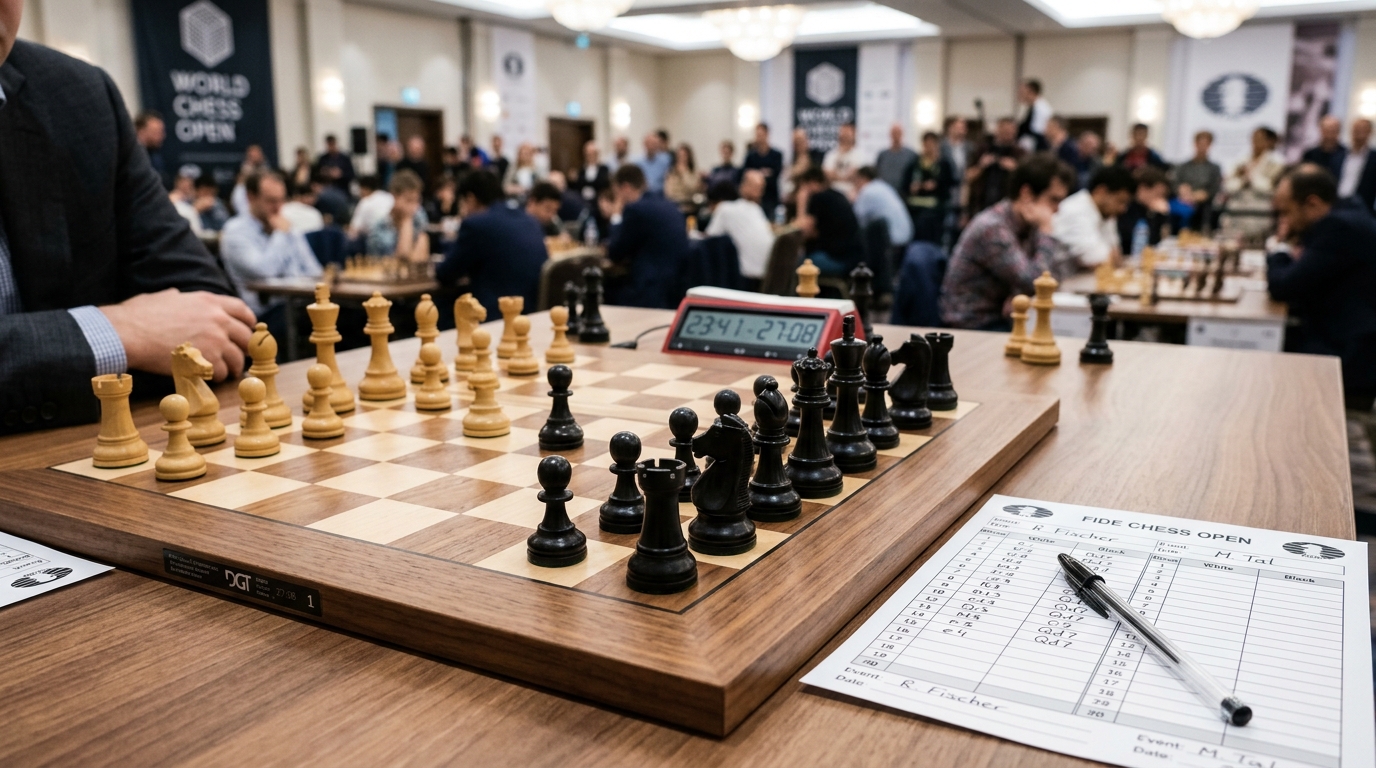
FIDE & USCF Score Sheet Rules: What Every Tournament Player Must Know
Entering an officially rated chess tournament can be intimidating. Beyond tactical blunders and clock management, competitive players must abide by the official rules governing game records. Under both the FIDE Laws of Chess (Article 8) and the US Chess Federation (USCF) Rulebook, maintaining a legible score sheet is not merely optional—it is a strict legal requirement.
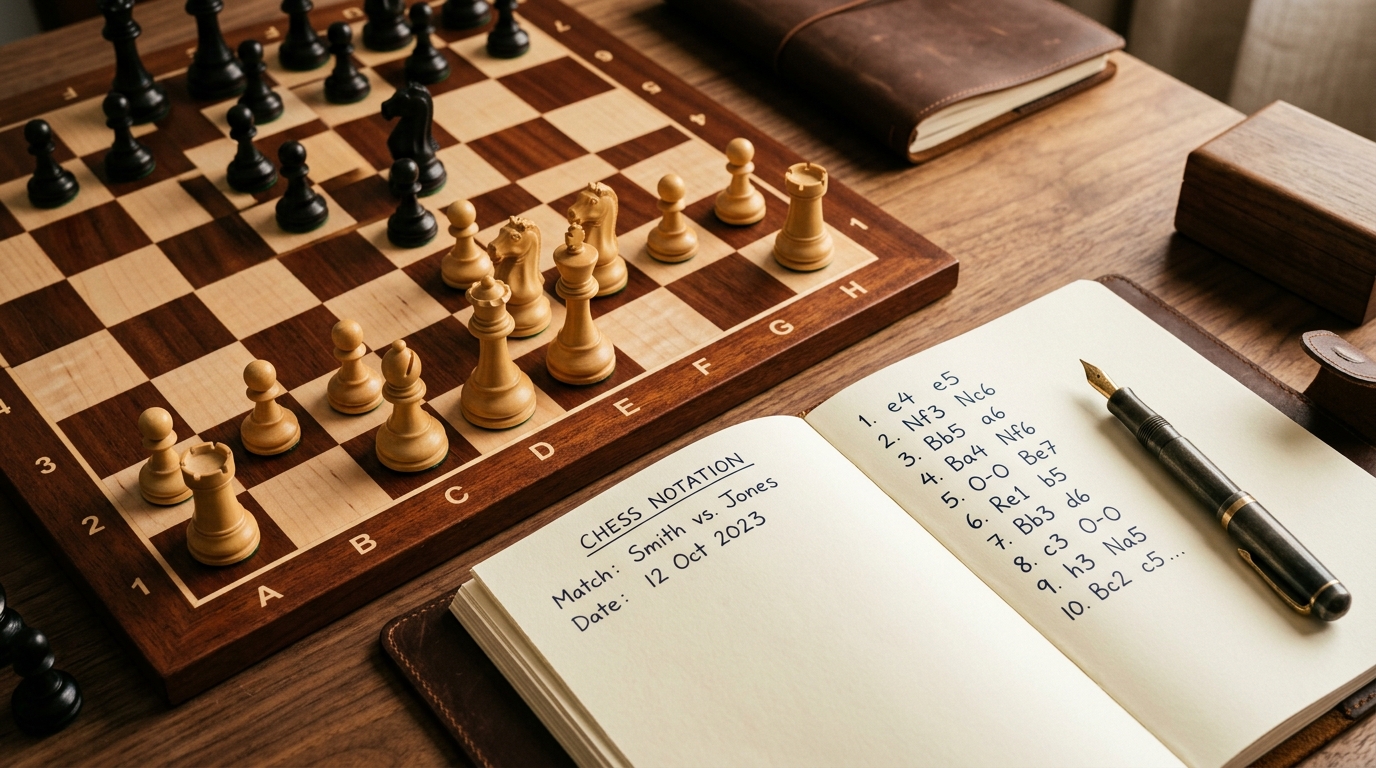
A well-maintained physical scorebook, such as the Overspire Chess Score Book, is your primary legal instrument to verify move counts, claim draws, and resolve arbiter disputes.
1. The Golden Rule: Move First, Write Later
In historical times, players would often write down their intended move on their score sheet before executing it, using the notebook as a memory check. Under current FIDE rules, this is strictly prohibited.
According to FIDE Article 8.1.1: "In the course of play each player is required to record their own moves and those of their opponent in the correct manner, move after move, as clearly and legibly as possible, in the algebraic notation of the Laws of Chess. It is forbidden to write the moves in advance, unless the player is claiming a draw."
The sequence must always be:
- Make your move on the board using one hand.
- Press the clock button with that same hand.
- Write down your move on your score sheet.
2. Visible Placement of the Score Sheet
Your score sheet or scorebook must remain visible to the arbiter and your opponent throughout the entire duration of the game. You cannot hide it under a coat, place it on your lap, or cover it with capture pieces. Both players have the right to observe the move count on the opponent's sheet.
3. Time Trouble Exceptions (<5 Minutes Remaining)
What happens when the clock is ticking down and you have mere seconds to move? FIDE provides a specific exemption for time scrambles:
- Without Increment: If a player has less than 5 minutes remaining on their clock and does not receive an addition of 30 seconds or more with each move, they are not obliged to keep notation.
- With 30-Second Increment: If the tournament time control uses a modern increment of 30 seconds or more from move one (standard in FIDE classical events), you must continue recording moves throughout the entire game, regardless of your remaining clock time.
4. Updating Your Score Sheet After the Scramble
If you stopped taking notation during a time scramble and the time control is reached (or your opponent's flag falls), the game pauses temporarily:
- You must immediately bring your score sheet completely up to date before making another move.
- You are entitled to use your opponent’s score sheet or an arbiter's demonstration sheet to fill in the missing moves, but on your own clock time.
5. Claiming a Draw: Threefold Repetition & 50-Move Rule
Your score sheet is the only admissible evidence when making technical draw claims:
- Threefold Repetition (Article 9.2): To claim a draw by threefold repetition, the exact same position must appear three times with the same player having the move and the same legal rights (castling and en passant). If you wish to claim a draw with your next move, you must write the move on your score sheet without playing it on the board, summon the arbiter, and state your claim.
- The 50-Move Rule (Article 9.3): A draw can be claimed if the last 50 consecutive moves have been made by each player without any pawn move and without any capture. The arbiter verifies this directly from both players' score sheets.
6. Signing the Score Sheets: The Binding Contract
Once a game concludes (whether by checkmate, resignation, draw agreement, or flag fall), both players must write the final result (1-0, 0-1, or ½-½) and sign both score sheets. Once signed, the result is official and cannot normally be challenged or overturned by the players.
Comparison: Official Tournament Rules at a Glance
| Situation | FIDE Regulation | Correct Action |
|---|---|---|
| Writing Move Before Playing | Strictly forbidden (Rule 8.1) | Execute move, press clock, then write. |
| <5 Min Clock (No Increment) | Scorekeeping excused | Focus on playing; catch up after time control. |
| Threefold Repetition Claim | Requires score sheet evidence | Write move, do not play on board, stop clock, call arbiter. |
| Game End | Mandatory signatures | Record result and sign both sheets. |
💡 Master Your Notation: Need a refresher on move symbols, en passant, or piece abbreviations? Review our Step-by-Step Chess Notation Guide or project your tournament rating shifts with our free FIDE & USCF Elo Rating Calculator.
Related Chess Training Guides
Tournament-Grade Layout for Serious Competitors
Don't risk illegible sheets or running out of room on move 40. The Overspire Chess Score Book provides 100 standardized sheets with room for 65 moves, event and round headers, and board diagrams for adjournment notes.
 View on Amazon ($7.99)