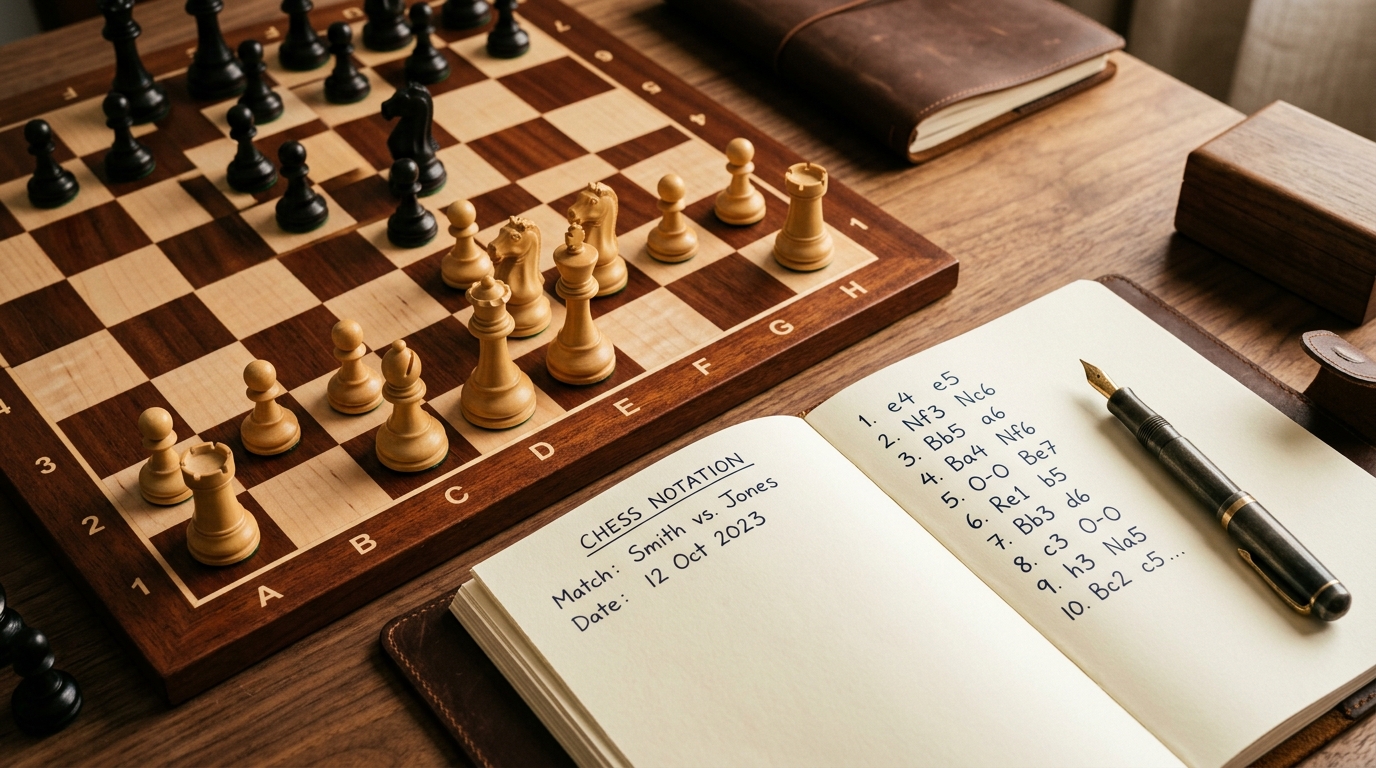
How to Read & Write Algebraic Chess Notation (Step-by-Step Guide)
Whether you are sitting down for your first official club tournament or playing casually with friends, knowing how to write down chess moves is an essential milestone. The international standard recognized by FIDE (International Chess Federation) and the US Chess Federation is Standard Algebraic Notation (SAN).
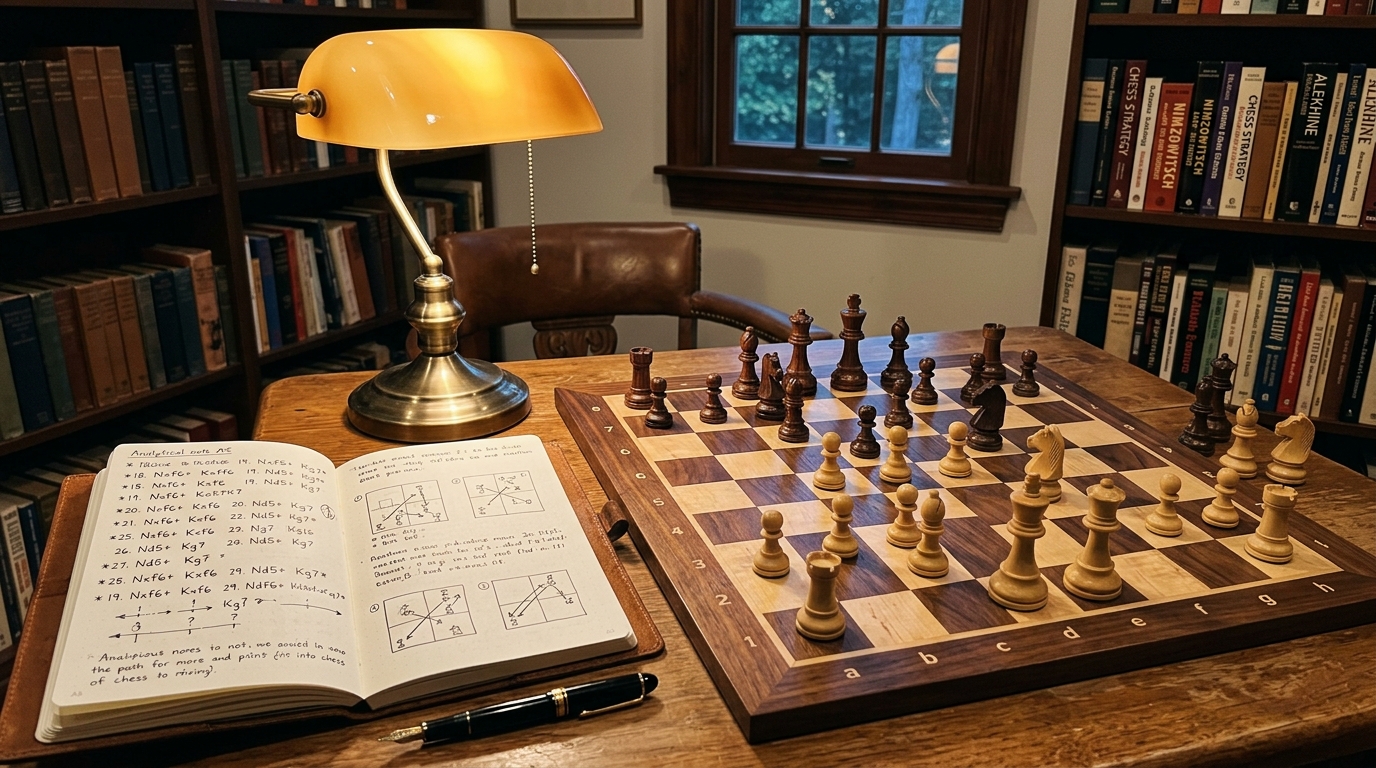
Recording your moves in a physical tournament chess scorebook enables you to preserve your best games, prove move counts during disputes, and analyze mistakes afterwards using our post-game analysis method.
1. The Chessboard Grid: Files and Ranks
Every square on a standard 64-square chessboard has a unique two-character coordinate, resembling a Cartesian graph:
- Files (Columns): The vertical columns running from White’s side to Black’s side are labeled with lowercase letters from left to right:
a, b, c, d, e, f, g, h. - Ranks (Rows): The horizontal rows are numbered from
1to8, starting from White's home side (Rank 1) to Black's home side (Rank 8).
Combining the file letter and rank number identifies each square. For instance, White’s King begins on e1, while Black’s King begins on e8.
2. Piece Abbreviations (Letters)
In standard English algebraic notation, each major and minor piece is designated by an uppercase capital letter:
- K: King
- Q: Queen
- R: Rook
- B: Bishop
- N: Knight (the letter N is used because K is already reserved for the King)
Crucial Rule for Pawns: Pawns do not have a capital letter. When a pawn moves, you simply write the destination square. For example, moving the king's pawn two squares forward on move one is written simply as e4, never Pe4.
3. Writing Regular Moves
To record a piece move, combine the piece abbreviation with the destination square:
Nf3= Knight moves to f3Bc4= Bishop moves to c4Qd1= Queen moves to d1e5= Pawn moves to e5
4. Captures, Checks, and Checkmate
Special symbols communicate what happens during the move:
- Captures (
x): Place anxbetween the piece letter and the destination square. Example:Bxf7(Bishop captures whatever unit was on f7). When a pawn captures, indicate the departing file, followed byx, then the destination square:exd5(pawn from the e-file captures on d5). - Check (
+): Add a plus sign at the end of the move when attacking the enemy King. Example:Qh5+. - Checkmate (
#): Add a hash symbol when the game ends in checkmate. Example:Qxf7#(Scholar's Mate).
5. Special Moves: Castling and Promotion
- Kingside (Short) Castling: Written as
O-O(capital letters O, or zeros). - Queenside (Long) Castling: Written as
O-O-O. - Pawn Promotion: Write the destination square, an equals sign, and the chosen piece letter. Example:
e8=Q(pawn advances to e8 and promotes to a Queen). - En Passant (
e.p.): When capturing en passant, write the pawn capture followed optionally by e.p. (e.g.,exd6 e.p.or simplyexd6).
6. Disambiguation: When Two Identical Pieces Can Move to the Same Square
If two identical pieces (such as two Rooks or two Knights) can legally move to the same destination square, you must specify which piece moved:
- By departing file: If they are on different files, indicate the file letter. Example:
Rad1(the Rook on the a-file moves to d1, while the Rook on the f-file remains on f1). - By departing rank: If they are on the same file but different ranks, indicate the rank number. Example:
R1d7(the Rook on the 1st rank moves to d7). - By file and rank: In extremely rare cases (usually after multiple pawn promotions) where file and rank are both ambiguous, write the full source square:
Qh4e1.
Quick Notation Cheat Sheet
| Symbol / Notation | Meaning | Example |
|---|---|---|
e4 |
Pawn move | King's pawn moves to e4 |
Nf3 |
Piece move | Knight to f3 |
x |
Capture | Nxe5 (Knight takes e5) |
O-O / O-O-O |
Castling | Short / Long castling |
+ / # |
Check / Checkmate | Qh5+ / Qxf7# |
! / ? |
Good move / Blunder | Annotated during post-game review |
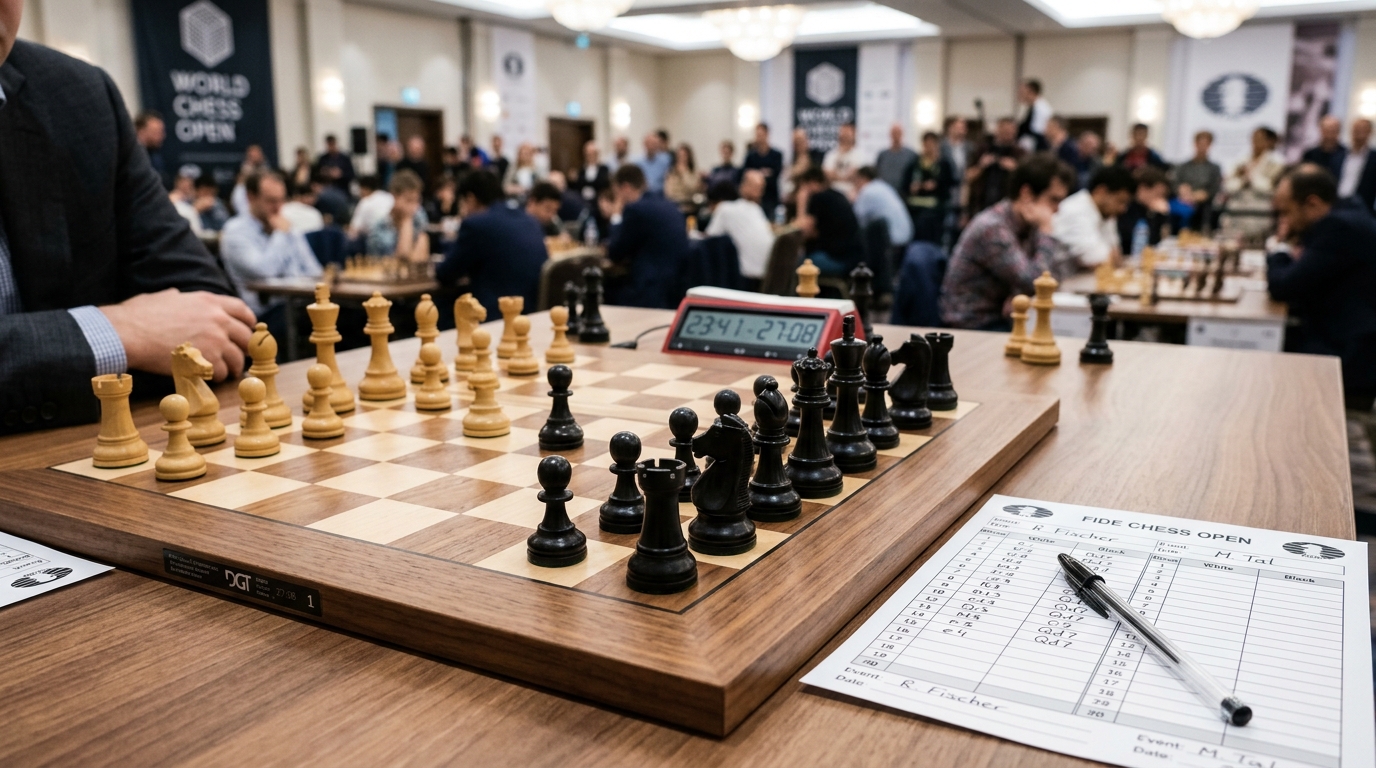
♟️ Tournament Regulations: Did you know FIDE rules prohibit writing your move down before making it on the board? Read our complete breakdown of FIDE & USCF Score Sheet Rules or calculate your rating changes using our Elo Rating Calculator.
Related Chess Training Guides
Practice on Real Tournament Score Sheets
The best way to build automatic notation reflexes is by using an official, dedicated scorebook. The Overspire Chess Score Book offers 100 tournament sheets, 65 moves per game, and empty board diagrams for post-game notes.
 View on Amazon ($7.99)